Introduction
As a business analyst, you’re often buried under data—raw numbers, spreadsheets, databases, dashboards. In 2025, Artificial Intelligence (AI) has evolved to help you not just process data, but to understand, visualize, predict, and use that data for real business decisions. But with so many AI-powered tools around, the big question is: Which AI is best for business analysts?
In this article, we’ll explore top contenders, compare their strengths and limitations, and help you choose the “best fit” depending on your needs — whether you’re a solo analyst, part of a small company, or working in a large enterprise.
What “Best” Means for a Business Analyst
Before diving in, what does “best AI for business analysts” actually mean? It depends on what you need:
- ✅ Ease of use / low-code or no-code — especially if you’re not a data scientist or don’t know heavy coding / SQL.
- ✅ Powerful data visualization & reporting — turning raw data into actionable charts, dashboards, and stories.
- ✅ AI-assisted insights, predictions & anomaly detection — not just dashboards, but deeper analytics: forecasting, root-cause analysis, trends, outliers.
- ✅ Natural-language / conversational interfaces — ask questions in plain English (or your language), not write long queries or code.
- ✅ Scalability & integration — ability to work with different data sources, databases, ERP/CRM, cloud data warehouses, enterprise tools.
- ✅ Flexibility for different tasks — from quick ad-hoc reports to complex predictive modeling or big-data analytics.
With these criteria in mind, let’s meet the top AI tools that many analysts and organizations use in 2025.
🧰 Top AI Tools for Business Analysts (2025)
Here are several top-tier AI / BI (Business Intelligence) tools — each with a slightly different sweet spot.
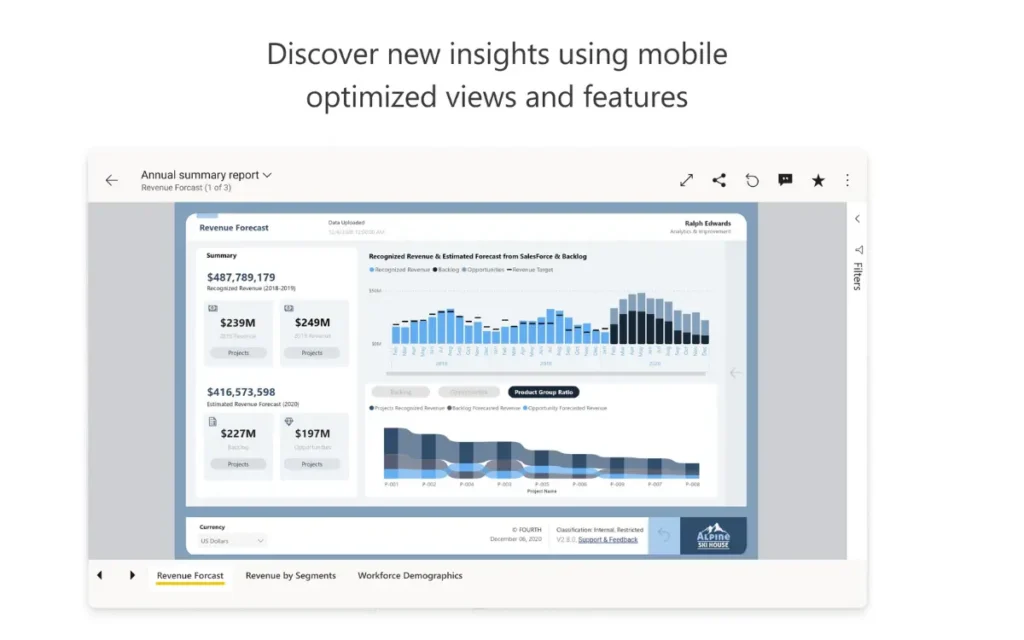
Microsoft Power BI (with Microsoft Copilot)
- Why it stands out: Power BI has long been a dominant BI platform. In recent years, its integration with Copilot has made it significantly more powerful: you can now ask questions in natural language and generate dashboards, visualizations, or reports automatically. Transformik+2thoughtspot.com+2
- Best for: Analysts and teams already using Microsoft ecosystem (Excel, Azure, Office 365, etc.), or companies wanting a cost-effective, all-in-one BI + AI solution. bitnotus.com+2LinkedIn+2
- Strengths: Natural-language queries, quick dashboard generation, integration with other Microsoft tools, scalability for small to large organizations. thoughtspot.com+2thoughtspot.com+2
- Limitations: For very advanced custom modeling/visualizations, or non-Microsoft environments, flexibility may be less compared to specialized tools. bitnotus.com+1
ThoughtSpot
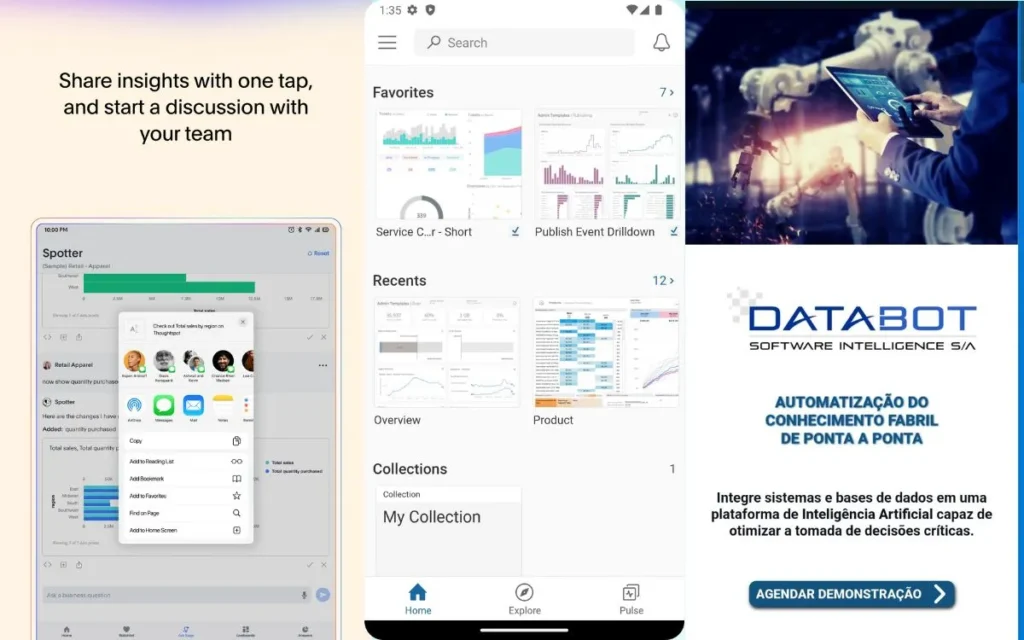
- Why it stands out: ThoughtSpot is built around natural-language / search-driven analytics — you just type questions like “What were our sales last quarter by region?” and get instant insights, charts, or dashboards. thoughtspot.com+2AI Magazine+2
- Best for: Teams wanting self-service analytics — letting non-technical users explore data without SQL or coding. Great for fast, on-the-fly insights. thoughtspot.com+1
- Strengths: Instant AI-powered insights, anomaly detection, trend analysis, flexible, easy for non-analyst stakeholders too. thoughtspot.com+2thoughtspot.com+2
- Limitations: For highly customized data science / ML modeling or very complex pipelines, may lack some depth compared to full-fledged ML/BI platforms. Analytics Insight+2codingem.com+2
Tableau (with AI / analytics add-ons)
- Why it stands out: Tableau is widely regarded as one of the best tools for data visualization and storytelling — turning raw data into interactive dashboards/reports that stakeholders understand. Its recent AI/analytics add-ons help with insight discovery and predictive analysis. codingem.com+2Secoda+2
- Best for: Analysts who prioritize visual storytelling, custom dashboards, interactive data exploration — especially in teams with more advanced data / BI needs. Transformik+2bitnotus.com+2
- Strengths: Strong visualization, flexibility, powerful analytics + AI-driven insight features (trend detection, anomaly detection), great for reporting to stakeholders. bitnotus.com+2BytePlus+2
- Limitations: More expensive licensing for full features; may require more expertise to get full value (compared to simpler/no-code tools). blazesql.com+1
DataRobot (AutoML & predictive modeling)
- Why it stands out: If your analysis needs go beyond dashboards and you want to build predictive models — for sales forecasting, risk modeling, customer churn prediction — DataRobot offers AutoML capabilities that let analysts build, validate, and deploy models with minimal coding. AnalyticsHacker+2BytePlus+2
- Best for: Analysts or teams needing predictive analytics, forecasting, classification tasks — especially when you don’t have a full-fledged data science team. AnalyticsHacker+2bitnotus.com+2
- Strengths: Automates model-building, reduces need for coding, offers explainability and deployment — bridging gap between business and data science. AnalyticsHacker+1
- Limitations: Licensing / cost may be a barrier; simpler BI tools may be more cost-effective for just dashboards / reporting. AnalyticsHacker+1
Which Tool is “Best” — Depending on Different Use Cases
There’s no single “best” AI for all business analysts. The right pick depends on what you want to do. Here’s a quick guide:
| Use Case / Need | Recommended Tool(s) |
|---|---|
| Quick dashboards, reporting from spreadsheets or existing data, minimal coding | Power BI + Copilot, ThoughtSpot |
| Non-technical stakeholders who want to explore data on their own (self-service analytics) | ThoughtSpot, Tableau |
| Rich data visualization & storytelling for stakeholders / management | Tableau, Power BI |
| Predictive analytics / forecasting / ML models (sales, risk, churn analysis) | DataRobot |
| Organizations using Microsoft ecosystem (Excel, Azure, Office 365) | Power BI + Copilot |
| Teams needing easy natural-language querying / ad-hoc insights | ThoughtSpot, Power BI (Copilot / Q&A) |
Real-World Example: How a Business Analyst Might Use AI
Imagine you are a business analyst in an e-commerce company:
- You use Power BI + Copilot to quickly load sales data from Excel/SQL, then ask: “Show me total sales by region in last 3 months.” Instantly, you get a dashboard.
- You spot a sudden drop in one region — using ThoughtSpot, you type: “Why did sales drop in Region X in the last 60 days?” AI spits out possible factors: lower ad spend, fewer new customers, higher returns, etc.
- You feed cleaned data into DataRobot to build a sales-forecasting model — predicting demand for next quarter, helping inventory planning.
- Finally, you use Tableau to build a polished report for stakeholders — interactive charts, filters, trend lines — that makes your insights easy to understand.
This workflow blends ease, power, speed, and depth — exactly what modern business analysts need.
What You Should Keep in Mind: Limitations & What AI Can’t Replace
- AI-powered tools simplify analysis — but they don’t replace human judgment. Data is rarely perfect; AI can miss context, bias, or unusual business conditions.
- For custom business logic (complex KPIs, special data transformations) — sometimes manual intervention or expert coding is still required.
- Cost/licensing can add up — especially for enterprise-grade tools or AutoML platforms.
- Data quality matters. If your data is messy, incomplete, or unstructured, even best AI tools may produce misleading outputs.
Hence, AI should be seen as a powerful assistant, not a full replacement for analytical thinking.
📌 My Recommendation: What to Use Right Now
If I were a business analyst starting today and want maximum value for effort:
- I’d begin with Power BI + Copilot (if I’m in a Microsoft environment) — for dashboards, ease, affordability.
- I’d add ThoughtSpot if I want non-technical colleagues to explore data themselves.
- If predictive analytics is important (sales forecasting, risk, demand, etc.), I’d use DataRobot.
- For final polished reporting and deep data storytelling, Tableau remains unbeatable.
In short: combine — don’t pick one.
FAQ — Common Questions About AI & Business Analysis
Q: Is AI going to replace business analysts?
A: No. AI accelerates and simplifies many tasks, but human insight, context understanding, business judgement, stakeholder communication — these remain human strengths. AI is a force multiplier, not a replacement.
Q: I don’t know coding — can I still use these tools?
A: Yes. Tools like ThoughtSpot, Power BI (with Copilot), and many features in Tableau / DataRobot are designed for “low-code” or “no-code” usage — natural-language querying, drag-and-drop dashboards, automated modeling.
Q: What if my data is messy or comes from multiple sources?
A: Many AI/BI tools support data integration from multiple databases, spreadsheets, cloud warehouses. But before using AI features, data cleaning / preprocessing is crucial — clean data yields better insights.
Q: Which tool is most cost-effective for a small business or startup?
A: Probably a combination of Power BI (basic / Pro license) plus a simpler AI-assisted tool — because you get powerful dashboards + AI insights at relatively lower cost compared to enterprise-grade platforms.
Conclusion
In 2025, AI has become a game-changer for business analysts. With the right tool — or rather, right mix of tools — you can move faster from raw data to insight, from insight to action.
There’s no one-size-fits-all. The “best” AI depends on your business, data volume, team, and goals. For many, a hybrid approach — combining dashboarding, natural-language analytics, predictive modeling, and polished reporting — will offer the best balance of speed, power, flexibility, and cost.